
Not every day at school was dark, but the saddest were those when I was evaluated.
In 1986, I was tested again and never told of my learning disability; dyslexia.
Every time they pulled me out of class, I wanted to cry.
As if trapped in a spotlight without warning, the heat instantly burned my cheeks. Sweat broke at my hairline, and my skin grew hot before my teacher could speak my name. The urge to grit my teeth and glare defiantly at the chalkboard was strong. Refusal to leave was clear in my unwillingness to move or even look toward the stranger at the door. But that would have only created an even greater spectacle.
So instead, I rendered myself invisible by disappearing as quickly and quietly as I could.
My sadness was like a stack of books weighing me down.
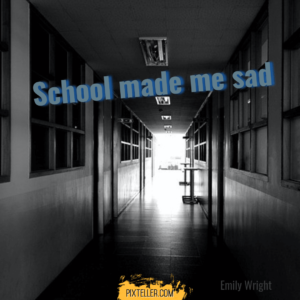
Not one destroyed day in particular stands out. No actual dates mark my ugly calendar of baggage. I only remember being yanked from every class at least twice a year. The slow walk down the empty halls to yet another tiny office unknown to students was unforgettable. As was of course, the relentless testing. These memories are impossible to tear from the childhood scrapbook in my mind.
Tattered pages of condescension and patronizing. Each time I was visited by a different, what? Educational therapist? Academic analysis? Learning behavioral specialist? I never caught their title, and didn’t care to know their names.
Recounting these sessions makes me sad.
No one ever asked me if I wanted to go. And no one ever told me why I was being tested. I may have been more cooperative if I had understood the long-term benefits of a conclusive diagnosis. Instead, I lashed out by purposefully foiling their exercises. My parents weren’t even aware of these backalley assessments. Nor did we ever learn of my results. I took this to be positive, like the adage, ‘no news is good news.’
I assumed I was being tested because I was stupid and THEY (the faceless ‘they,’ no one ever calls by name or identifies). They wanted to know how stupid I really was. They wanted to determine if I was deserving of my current grade, or whether I needed to attend an institution.
Staring unfocused at something just over their left ear while allowing spittle to collect at the corner of my lip was tempting. If only to give them something more to report than…
…my inability to read.
But I was terrified of where that might land me. A rubber room, perhaps?
A kid in my class once said that I was being interviewed for special ed or the community living classes, as we called it back then. I wasn’t sure what the outcome of my results would bring and fought the strain of tears that threatened. Rage and frustration flooded my view and marred my perception.
It was not until university that I discovered I had a learning disability called dyslexia.
Did they really think that they could pluck me from class for an hour and have me return without notice?
As if elementary kids are known for their empathy and sensitivity. Discretion was a given. My classmates would just pack away their curiosity and forget that one student was allotted special treatment to miss out on math class. Right? No one would ask questions about or mention my absences. Understanding runs rampant in schools, right? I thought I was supposed to be stupid. Inevitably, some kids would say I was lucky to get out of class and assume that where I went was fun. They would argue favoritism and demand the same opportunities. Until another kid not so subtly announced that…
dumb kids don’t get perks.
It was so unfair and disruptive. It took hours before something else would steal away their attention and I could curl back into myself.
And all for what?
It wasn’t as though it changed anything. Once my brief absence was forgotten by my fellow students, life returned to normal. I would continue struggling along through school, doing my best to blend in, and avoid outing my stupidity, until the next surprise evaluation.
I learned later in my academic career that all of my teachers knew of my learning disability. They weren’t allowed to mention it to me or my parents, only suggested extra help with reading. They couldn’t advise my future teachers to prevent bias against me. Hah! Each of my teachers had to figure it out on their own that I had a learning disability. By the time they got to know all thirty of their students and deciphered my limitations, we were halfway through the school year. Cue the evaluation request. Oops, we ran out of time. Push her through to the next grade and see how she makes out.
Back then, there were no resources for kids who required alternative methods of teaching. I was considered an angry kid who grew up to be an outspoken, opinionated, angry teenager. Several factors played a role in my attitude, and my earliest memories of school account for too many. I remember finger painting in kindergarten.
There I was, standing at the easel in one of my dad’s old shirts backwards so as not to spoil my clothes. True to myself, I refused to do what was expected or what the other kids were doing. So, my grass was blue and my flowers were green. The paint was mucky on my hands while hardened blotches cracked on my face. It’s a vivid memory, and I will never forget the red. That was the colour of the X at the top of my page left by my teacher. It was out of place. It was a mistake. How could my finger painting; a child’s artwork of flowers be wrong? That X scarred me. Two deep cuts branded me, misplaced and cruel. I knew that there was something wrong, and it was not me.
In grade two, my teacher played an instrumental song, and we were all told to draw what we thought of as it played. Everyone recognized the tune. It was the familiar theme of Zorro. I knew that everyone would draw a horse galloping or a masked man riding the range. I pictured a dancer jumping and twirling. My ballerina may have been pretty good, if not for the giant X scratch through my paper. There it was again. At first, I thought my teacher had meant to draw a Z. Until a painted fingernail pointed at my page. ‘That’s wrong,’ she said without compunction or apology. I was wrong. The air in my chest was too heavy to heave. The hurt was too bitter to swallow. I fought the urge to run from the place I clearly did not belong.
To this day, I harbor great resentment towards red pens and Xs. They lack compassion, originality, and articulation. They are for the weak and the lazy. Especially in subjective matters. State your case and use your words if you don’t like something.
This was my reality throughout elementary school. High school was worse. But that’s another story.