Tag Archives: learning disabilities

1982 Brutal Truth: Sour Note

This is my brutal truth; unknowingly growing up with a learning disability in 1982

Music always hits a sour note when trying to learn while unknowingly dyslexic.

The hushed tones of my mother were barely audible, but the deep baritone of Mr. Lanza was unmistakable. Never had I assumed to be his star pupil, but his words cut deep just the same. 

What was wrong with me? Why did I never learn?
Brutal Truth 1982: Sour Note
DW: Sour Note

At seven, I hadn’t known the difference between piano and organ lessons. My music teacher taught both after all yet, the piano sat front and center of his tiny parlor while the organ was deliberately tucked into the corner. Not until I was swallowed by the darkness of the car did my mother scold me for playing the piano. 

I thought I had broken the rules, or that I had done something dreadfully wrong to embarrass my mother so. By playing the piano at my intended organ lesson, I had betrayed my mother. So, she had put an end to my organ lessons. This should have made me happy. After all, it was what I had wanted. Was it not?

Music lessons were just another sharp piece of my childhood.

When it floated around, I would break into a cold sweat and clasp my hands as a way to keep them from shaking. 

It was like scheduling a weekly nightmare.

Every Tuesday at 6:30 pm, I would have to read aloud for an hour. This was my biggest fear. Half of the lesson was theory. Here, I literally had to read the music notes aloud.

The other half was practical, where my fingers outed me for the illiterate fraud I was to an extremely staunch Mr. Lanza. Compared to the many big scary men in my life, Mr. Lanza, my music teacher, was a gummy bear. A hairy, stout gummy bear that smelled of spicy aftershave. But that did not mean that he could not be daunting. The way his shoulders hunched with every wrong note or careless fingering was worse. In some ways, his defeated slump was more difficult than any harsh word or deep scowl.  

In grade two, I had enough trouble reading words, let alone music notes, on a page full of clustered lines. Practicing never seemed to help, so I never bothered with it, despite of my mother’s gripes.

Like every child, I wanted to be liked and accepted, especially by those who were likely to pass judgement or evaluate. 
Growing up Dyslexic; Music
Sour Note; pic 2

By continuously disappointing and frustrating Mr. Lanza, he practically curled into himself. Like every note was a slap.

As he shrank beside me, so did my hopes of earning his approval and favor.

This did not stop me from trying, though. True to my talents, I did all that I could to distract the man from the task at hand hoping that he would overlook my musical misgivings. Maybe he would find something else about me that was likable.    

Each week when I entered the bright parlor, the gleaming baby grand piano greeted me first. 

It was so beautiful. Dark cherry wood was so stunning that I would stop in the doorway just to stare at it before I turned my back to it to sit at the organ.Yep, an organ. Neither of my parents played an instrument. Yet, one of their prize possessions was a flippin’ organ that did nothing in the front room of our home but collect dust.  Okay, that’s a lie. My sisters played. Not often, but way more than I did.

Thankfully, my feet did not reach the pedals, so I only had to learn the notes and my fingerings. Which was bad enough.

“Miss. Emily. What is that note? That one, right there?” Mr. Lanza asked with more patience than I deserved, because after many weeks, I still didn’t know. “Every, Good, Boy, Deserves, Fudge. Remember? Every. Good.” His pointer scratched and thumped the page propped up in front of me with every word. “Every. Good.” He repeated, and I realized that I was being prompted.

“Boy! B! It’s a B.” I said.

“It’s a B.” He said in the tired voice I was becoming to know. 
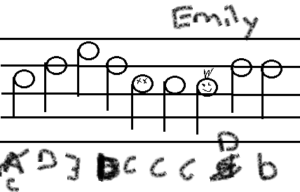
Dyslexic Writer; Sour Note
SourNote – 2

“Mr. Lanza?”

“Yes, Miss. Emily.”

“Would you play it for me, so that I can hear what it’s supposed to sound like?” I asked.

This was my usual request, one that he was reluctant to indulge but always did. And it worked. I could feel the stress lift from him when he played. His odd, hairy knuckles gently curled as he plucked delicately at the keys. Not only did this break the tension, which seemingly straightened his spine, but this was how…

I learned all the pieces assigned to me; I watched his fingers, memorized the keys, and secured the melody to my mind. 

After we switched places, he was taller than me again. The music changed him; it had the power to lighten him. The always proper Mr. Lanza would be slumping again with the turn of a new page. My random jabs at the organ keys, my wandering eyes over the foreign lines and notes, weighed him down. Biding my time, I waited for his pointer to slap the page, a sure sign of his growing irritation with his unteachable student.

“Mr. Lanza?”

“Yes, Miss Emily?” He asked,his question was more of a sigh of exhaustion.

“Could we maybe play at the piano?” 

Beneath his large, caterpillar-like eyebrows, his gaze slid from me to the piano and then back to me. 

Did he know that this was an effort to distract? 

With a slow nod, he seemed to decide on something bigger than switching instruments. With that, I pulled the music book from its decorative stand and sat in aw behind the enormous beautiful piano. That particular piece did not sound any better, even to my ear. In fact, I was sure that my playing alone was an insult to the baby grand’s craftsmanship.

The agony did not last long before we heard my mother slip into the adjacent waiting room. Her boots bumped off the snow as quietly and politely as possible. With that, Mr. Lanza stood and tugged at the bottom of his jacket.

“Miss. Emily, I would like you to work on your scales now.”

“Alright, Mr. Lanza.” I said, happy to be at the end of our lesson even though it seemed rather early.

That’s when I heard it. 

I had completed the scale in C major. Set in the pause as I repositioned my hands, were the harsh tones of my teacher. Straining to decipher my mother’s soft words, Mr. Lanza’s were unmistakable. Bass travels further than treble. Did you know that? 

“Give up on this one, Mrs. Wright.” He said. 

A stone I hadn’t known to be on my chest swelled coldly until it pressed against my throat. It was hard to breathe and harder to swallow. With panicked trembling hands, I flipped the pages of my book nervously as a way to drown them out. Not wanting to hear the rest of their conversation, I busied myself by playing C major scale again and again, not daring to make a mistake. Pain shot through my lips as I bit them together in hopes to will my eyes not to well up or drop tears on his beautiful piano keys. 

Rejection, even if warranted, can leave its scars. 

“Emily. It’s time.” My mother said, and I slipped between them and out the door as soundlessly as possible. 

The car ride home was quiet and cold. The December dark had swallowed the early evening sky, leaving even the clouds lonely. The heater blasted, but offered no comfort. There, I waited through her deafening silence because I knew that she was beyond mad.

I had disappointed her again with my failure to learn, my defiance to play, and my betrayal of the organ. 

She never told me that I would not be going back to Mr. Lanza’s, but the icy spot on my heart knew that I would never see the kind man again. My chance to say goodbye and thank him for his hopeless efforts was gone forever. 

It was four years later when Mr. Lanza made it through to the forefront of my thoughts. 

My grade six teacher loaded a wire contraption that held and aligned 5 pieces of white chalk. Immediately after pressing it to the blackboard with one long straight stroke, I recognized the music stand of my childhood books. 

For the first time at school, I was familiar with a lesson before my teacher could begin. 

In every space between the lines, Mr. McGregor drew a circle. In each circle, he wrote a letter. F-A-C-E. Then he moved on to the lines. In these circles, he wrote E-G-B-D-F. I saw it! For the first time in my life, I saw it. Right there laid out in front of me, so simple, so basic.  

Before I could stop myself, I was standing. In the middle of my classroom staring at the chalk board. “I get it! I finally get it!” 

The jeers and snickers from the other kids were easily ignored. My fellow classmates did not faze me. It was as if someone had flipped on a light and I was finally able to see. The joy I felt bubbled up and fizzed, making sitting an impossibility. 

The stars had somehow aligned, and I could see something that had been right in front of me all along. 

One disapproving glance from Mr. McGregor did not dash my enthusiasm, but it sobered me enough to take my seat.  

For a long moment, I could only stare at the two distinct note arrangements on the board. Right there in black and white, I could see the piece that was missing from the beginning. The alphabet. Why would you separate the notes by lines and spaces to come up with ridiculous sayings?  

“The spaces are F-A-C-E and the lines make up Every Good Boy Deserves Fudge; E-G-B-D-F.” They would say.

When you put them together, you get E-F-G-A-B-C-D-E-F. Why would no one ever point out the already known pattern of the alphabet? 

Did no one ever consider that there might be a different way of teaching, especially when faced with a student who seems unteachable but not unwilling?

I am dyslexic, and this is my brutal truth.
 

1986 – Sad

1984 – Fever

1989 – Panic

1990 – Fear

1992 – Anger

1993- Crushed

1995 – Fraud

1993 Brutal Truth: Crushed

High school was worse!

Unknowingly dyslexic in 1993. I was crushed.

The humiliation was not nearly as often but was far more scarring.

I am dyslexic and here is my brutal truth. 

Dyslexic: 1993
My Brutal Truth


Sunlight pouring in from behind me caught on something unexpected and shiny. I was already flinching when hairy knuckles rapped on my desk. If it were my attention that he had wanted, he got it. His hand in my direct eyeline and the glinting gold band squeezing around his finger had been distracting enough. The startling knock, inches from my face, was unnecessary.

Bent over my desk, I had been lost in my own continuous stream of thoughts, and the ink was struggling to furiously keep up. The words I had been about to scratch down halted at the end of the pen and I willed for my memory to desperately snatch them while I lifted my eyes. Too late, they were gone; at the speed of a thought into the abyss of forgotten fragments of time. Before me was a sentence left unfinished; my train of thought was reduced to a wreck.

More disappointed than annoyed,

…I looked at my Grade 12 English teacher. His back was to me as he walked towards his desk. Lowering himself into his chair, Mr. Fenton peered at me over his reading glasses, made tiny by his rutted round face. When he raised his wiry brows without breaking his impatient stare, it suddenly occurred to me that I was meant to follow.

We were studying Shakespeare’s Hamlet, a play I knew well thanks to Mel Gibson. The remainder of the period was ours to begin the written assignment. Before I reached his desk, Mr. Fenton jutted his chin.

“Bring your work.” This was an obvious oversight on my part, given his tone.

More annoyed than disappointed,

…I approached the big desk that stood demanding respect front and center of the classroom. A sitting Mr. Fenton was at an awkward height, and I could see the oily pores of his slick, near-bald head. It was hard to ignore the heat shooting up through to my ears brought on by the open glances of curious students. An anonymous snort pulled Mr. Fenton’s eyes from my paper to the instantly quieted class. No one dared to meet his gaze, and before us, a plain of crowns lowered.

The painful silence stretched on while his dark eyes challenged his students. My discomfort only grew. Why was I there? What was going on? Should I grab a chair? What was I supposed to do with my hands?

Doubt and insecurities invaded me entirely.

The scent of garlic polluted the air when Mr. Fenton returned to my work and huffed. Never had he apologized for his weakness for the cafeteria Ceasar salad; an omission he often made as an explanation for his sour breath. 

Our assignment had just been given to us at the beginning of class, not even twenty minutes earlier. What could I possibly have written that would warrant this much scrutiny? How could he evaluate me on my preliminary notes, which were more of an illegible flowchart? 

“Blood.” He finally said, and I nodded.

Realizing that he wasn’t looking at me, I confirmed with a typical teen response. “Yep.”

“Yes.” He held the ‘s’ until garlic tainted the air again.

“Yes,” I echoed.

Referring back to my paper, he started listing off all of my points thus far. I wasn’t about to lean over his desk to follow the tip of his fancy pen as he tapped it around my written notes. Even at sixteen, I was well aware of the scene that would create. Self-consciously, I slid the small charm at my throat back and forth on its chain while taking stock of my shirt with its scoop neckline. Nope. No leaning today.

“All of your examples are in the literal sense. Battle, death and sickness.” From over his shoulder, his eyes found me again. “Come on, think. What else?”

I knew that I was staring at him blankly, but not for lack of an answer, more from the pure shock that I had been centerd out like this.

Although I felt colour rise to my cheeks, my lips grew cold from my gaping.

Suddenly, Mr. Fenton rolled back and stood, snagging the attention of the entire room. “You sit here and think about it.”

“What?” I could not keep the chilling surprise or volume from my voice.

Equally confused expressions looked back at me from the rows of my peers. Mr. Fenton’s fingers curled around my upper arms and dug in as he plopped me into his chair and steered me towards his desk. Panic and embarrassment swelled inside me, and a bolt of pressure raced to my head. Wildly, I scanned the room looking for a kind understanding face when I spotted a friend. Her contorted mouth said it all. Clearly, the odd behavior of our teacher had not gone unnoticed, but…

…no one else felt the uneasiness coil coldly down their spines. 

Paralyzed by fear, forever tethered to the fourth grade, I sat motionless at the front of the room. Feeling so small and fragile, a single breath could cause me to break. My mind whirled around the senseless humiliation. I tried to reach back to where I was before Mr. Fenton interrupted my work. Fingers of thought flicked through my memory trying to grasp at anything that had been there, but my pounding heart pulled all threads from my grasp. I had nothing. It was gone.

I picked up my teacher’s heavy pen and lowered it again upon sight of my trembling hands. Did he really expect me to be able to explore the concept of blood in the play more deeply from his desk? 

Thankfully, the bell rang blared before I had to find out. Mr. Fenton was leaning on the window ledge at the back of the class when I darted back to my desk to collect my things and flee from the room.

By the following day, I had reasoned that Mr. Fenton had no way of knowing the deeply rooted fear he had inflicted upon me with his actions the day before. So, I did all that I could to push it from my mind and not drag it with me back to English class. I had barely sat down when Mr. Fenton began to bellow instructions to the class. We were to pick up where we had left off the day before, and then, to my horror, he said my name.    

‘Ms. Wright,’ he hissed the ‘s’ like a ‘z’.

My eyes snapped to his, and he motioned for me to follow him out into the hall. The mass that had collected in my throat was too much to swallow, so I took to chewing on my tongue to ward off the tears. My heart clobbered so hard that it hurt to breathe.Out the door, I went, but he was already walking down the hall. Then he turned, where I hadn’t known there to be a room. When I got there, it was the side entrance into an office I didn’t recognize. The name on the desk was not Mr. Fenton; it was Mrs. Blackwell, the Vice Principal and my teacher looked disturbingly satisfied as he slid into the big wingback chair. Cautiously I took the seat across from him. 

There was one window looking out over the courtyard directly behind the desk, and Mr. Fenton’s glowing silhouette was almost ironic. Shadows created by the few secretaries in the main office, blurred beyond the closed blinds of the wall of glass to my right.

“I see that you have enrolled in the OAC English class next semester.” His gaudy ring caught the sunlight again as he steepled his fingers, pressing his elbows into the soft arms of his mobile throne.

This wasn’t a question and my plans were well thought out and precise. My high school excelled and specialized in the sciences, not my particular expertise. The idea was to take all the required OAC courses needed for my university application as quickly as possible so that I could add electives to my transcript in my final year. That way, I could enroll in courses available at other high school’s from the surrounding area and use my spare class for commuting. As well, English was by far my worst subject, so by taking it early I could enroll in an upgrade summer course, offered only to students who had already completed OAC English. 

I had no illusions about my limitations and academic challenges. My plan was to accept my disadvantages and get ahead of them.

It was perfect. Or at least I thought it had been before this blindsided ambush.

“I want you to take a look at this.” Mr. Fenton opened a folder that had been sitting on the plastic desk protector and plucked out papers. He held them towards me, but I had to stand to retrieve them. There were three or four pages neatly stapled together. “That is an essay written by a student of mine last year. It is an example of where you are expected to be. Where your writing should be.”

Flipping through the pages, I feigned interest all the while the date kept flashing in my mind. It was October! The semester had just begun. This was hardly enough time for teachers to learn all of their student’s names, let alone their potential. How could Mr. Fenton possibly know anything about my writing? We had yet to hand in a single assignment. The next thing he said tore me from my thoughts.

“I think that you should drop out.”

I froze without being able to look up.

These few words crushed me. 

“I teach OAC English, and you don’t have what it takes to pass that class.”

After that, I didn’t hear anything else he had to say. He had just obliterated my plans for high school, shattered my expectations for graduation and quashed any hope I had for getting into university. I had been judged and unfairly evaluated without any grounds or cause. There had yet to be anything for him to come to such a rash conclusion. I vaguely remember nodding and floating out of the room.

Three months later,

I sat hunched over another desk. Rows of them had been set up in the gym for exams.

It was believed that lower temperatures were stimulating and more likely to keep students alert. I must have been the exception because being cold made me want to curl up and sleep. Being my third exam, I had come prepared with a piping hot tea, a giant box of tissue and a toque. The thick wool of my puck bunny sweater helped too. Before me was my English exam, and I was ready. There was no stressing because I knew my stuff. It helped too that I wasn’t enrolling in OAC English until September, which knocked my plan off course by a year. By dropping the course as suggested by my teacher, I would not be eligible to apply for university until the year after my classmates; a reality I had learned to accept over the last few months.

A hairy knuckle dropped onto my desk, knocking mere inches from my pen. The scent of garlic had preceded him. Beneath my enormous sweater, I stiffened and gripped by Papermate so tight the tips of my fingers turned a ghostly white. Then, Mr. Fenton crouched beside me. So close, in fact, that I could see a roll of skin attempting to fold over the wire arm of his reading glasses in my peripheral. This time I did not lift my pen nor turn to him; my sights were set on the last few words to finish my train of thought. He seemed to wait, but still I wrote. Finally, Mr. Fenton placed my last assignment upon my desk. The grade was hard to miss in its giant red ink. 

Our final independent study, making up 40 percent of our final grade, had multiple components. Mine was on a local poet, and after much research and obscure digging, I had discovered the poet’s glossary. As if he had his own language, I used the glossary to decode and translate a number of his poems. No doubt about it, this poet was a sexist womanizer, and I said as much in my oral presentation, except I think I went as far as to say he was a pig. 

There I was, where I shone brightest at the front of the class, prepared to present on a topic I knew inside and out. Having a completely entranced, captivated audience was exhilarating until my teacher interrupted. As luck would have it, or my bad luck as it were, Mr. Fenton knew the poet. They had gone to school together and shared pints just a few weeks earlier. This blow took the wind right out of my sail. I had just openly trashed my teacher’s buddy. 

After a long awkward moment, Mr. Fenton choked out a laugh and announced that I had ‘hit the nail on the head’ with all that I unearthed;

another potentially brilliant day gone badly.

That had been weeks earlier, and the anticipation of my grade for that blunder of an assignment had been overshadowed only by my exams. I gleaned no insight into my results, not through rumor nor teacher’s meeting. The hopefulness I had for the written component withered. Let’s just say that my presentation had been kind and humorous in comparison to the strong language I used in my essay. 

Words like predator and pedophile lack comedic value and sharpen the edges of real accusations with well-argued points. Learning my teacher knew this poet personally was enough for me to enroll in summer school to redo grade 12 English upon my certain failure of the class.

Staring down at the bleeding red ink, a 98  looked back at me. Disbelief snatched my response as I forced myself to consider the mark. Percent, right? Was he for real? The air in my chest turned to lead, and a flood of emotion took hold, rattling me to the core.

Flattening his hand over my paper, Mr. Fenton’s football ring failed to glint under the harsh fluorescent lights of the gym.

“I underestimated you. Good job.” Still, I stayed silent. Standing, Mr. Fenton slipped his oversized hands into the little pockets of his suit jacket. “It’s too bad that you dropped my course next semester.”

To that, I could only dip my head.

Again, he had crushed me

…and I refused to allow him to wreck my thoughts. The scent of garlic faded as he strolled away.

Undefined emotions milled about my brain until my eyes landed on my pen. There was a task at hand that deserved all of my attention. After a number of centering breaths, I absentmindedly slipped my near-perfect assignment beneath my exam and continued to write.  

I am dyslexic and this is my brutal truth.

1981 – Sour Note

1984 – Fever

1986 – Sad

1989 – Panic

1990 – Fear

1992 – Anger

1995 – Fraud

1986 Brutal Truth: Sad

Not every day at school was dark, but the saddest were those when I was evaluated.

In 1986, I was tested again and never told of my learning disability; dyslexia.

Every time they pulled me out of class, I wanted to cry.

As if trapped in a spotlight without warning, the heat instantly burned my cheeks. Sweat broke at my hairline, and my skin grew hot before my teacher could speak my name. The urge to grit my teeth and glare defiantly at the chalkboard was strong. Refusal to leave was clear in my unwillingness to move or even look toward the stranger at the door. But that would have only created an even greater spectacle.

So instead, I rendered myself invisible by disappearing as quickly and quietly as I could.

My sadness was like a stack of books weighing me down.

Not one destroyed day in particular stands out. No actual dates mark my ugly calendar of baggage. I only remember being yanked from every class at least twice a year. The slow walk down the empty halls to yet another tiny office unknown to students was unforgettable. As was of course, the relentless testing. These memories are impossible to tear from the childhood scrapbook in my mind.

Tattered pages of condescension and patronizing. Each time I was visited by a different, what? Educational therapist? Academic analysis? Learning behavioral specialist? I never caught their title, and didn’t care to know their names.

Recounting these sessions makes me sad.


Dyslexic Writer; Brutal Truth 1986
Sad

No one ever asked me if I wanted to go. And no one ever told me why I was being tested. I may have been more cooperative if I had understood the long-term benefits of a conclusive diagnosis. Instead, I lashed out by purposefully foiling their exercises. My parents weren’t even aware of these backalley assessments. Nor did we ever learn of my results. I took this to be positive, like the adage, ‘no news is good news.’
I assumed I was being tested because I was stupid and THEY (the faceless ‘they,’ no one ever calls by name or identifies). They wanted to know how stupid I really was. They wanted to determine if I was deserving of my current grade, or whether I needed to attend an institution.

Staring unfocused at something just over their left ear while allowing spittle to collect at the corner of my lip was tempting. If only to give them something more to report than…

…my inability to read.

But I was terrified of where that might land me. A rubber room, perhaps?

A kid in my class once said that I was being interviewed for special ed or the community living classes, as we called it back then. I wasn’t sure what the outcome of my results would bring and fought the strain of tears that threatened. Rage and frustration flooded my view and marred my perception.

It was not until university that I discovered I had a learning disability called dyslexia.

Did they really think that they could pluck me from class for an hour and have me return without notice?

As if elementary kids are known for their empathy and sensitivity. Discretion was a given. My classmates would just pack away their curiosity and forget that one student was allotted special treatment to miss out on math class. Right? No one would ask questions about or mention my absences. Understanding runs rampant in schools, right? I thought I was supposed to be stupid. Inevitably, some kids would say I was lucky to get out of class and assume that where I went was fun. They would argue favoritism and demand the same opportunities. Until another kid not so subtly announced that…

dumb kids don’t get perks.  

It was so unfair and disruptive. It took hours before something else would steal away their attention and I could curl back into myself.

And all for what?

It wasn’t as though it changed anything. Once my brief absence was forgotten by my fellow students, life returned to normal. I would continue struggling along through school, doing my best to blend in, and avoid outing my stupidity, until the next surprise evaluation.

I learned later in my academic career that all of my teachers knew of my learning disability. They weren’t allowed to mention it to me or my parents, only suggested extra help with reading. They couldn’t advise my future teachers to prevent bias against me. Hah! Each of my teachers had to figure it out on their own that I had a learning disability. By the time they got to know all thirty of their students and deciphered my limitations, we were halfway through the school year. Cue the evaluation request. Oops, we ran out of time. Push her through to the next grade and see how she makes out.

Back then, there were no resources for kids who required alternative methods of teaching. I was considered an angry kid who grew up to be an outspoken, opinionated, angry teenager. Several factors played a role in my attitude, and my earliest memories of school account for too many. I remember finger painting in kindergarten.

There I was, standing at the easel in one of my dad’s old shirts backwards so as not to spoil my clothes. True to myself, I refused to do what was expected or what the other kids were doing. So, my grass was blue and my flowers were green. The paint was mucky on my hands while hardened blotches cracked on my face. It’s a vivid memory, and I will never forget the red. That was the colour of the X at the top of my page left by my teacher. It was out of place. It was a mistake. How could my finger painting; a child’s artwork of flowers be wrong? That X scarred me. Two deep cuts branded me, misplaced and cruel. I knew that there was something wrong, and it was not me.

In grade two, my teacher played an instrumental song, and we were all told to draw what we thought of as it played. Everyone recognized the tune. It was the familiar theme of Zorro. I knew that everyone would draw a horse galloping or a masked man riding the range. I pictured a dancer jumping and twirling. My ballerina may have been pretty good, if not for the giant X scratch through my paper. There it was again. At first, I thought my teacher had meant to draw a Z. Until a painted fingernail pointed at my page. ‘That’s wrong,’ she said without compunction or apology. I was wrong. The air in my chest was too heavy to heave. The hurt was too bitter to swallow. I fought the urge to run from the place I clearly did not belong.

To this day, I harbor great resentment towards red pens and Xs. They lack compassion, originality, and articulation. They are for the weak and the lazy. Especially in subjective matters. State your case and use your words if you don’t like something.

This was my reality throughout elementary school. High school was worse. But that’s another story.

I am dyslexic, and this is my brutal truth.
1981 – Sour Note

1984 – Fever

1989 – Panic

1990 – Fear

1992 – Anger

1993- Crushed

1995 – Fraud

1995 Brutal Truth: Fraud

Fraud

Until 1995, I was unknowingly having dyslexia. This is my brutal truth.

Being accused of fraud was one of the best things that ever happened to me.

Fraud. This is exactly how I felt attending University- a fraud. Somehow, I managed to graduate high school with a GPA that snagged an acceptance to my preferred post-secondary education establishment. This was a feat in itself because…

I pulled through high school without reading a single book cover to cover.

My trick? Well, I took impeccable notes, that only I could translate, and I made a point of writing essays that regurgitated the opinions of my teachers as discussed in class. I wore a path in the library carpet directly to the Cole’s Notes section and specifically chose books that had been made into film, no matter how obscure. Imagine what I could have done if Google had existed back then. Anyway, all of my diversions into reading worked like a charm. Or so I had thought.

Until the day I was asked to stay after one of my first-year university tutorials.

Upon hearing my name, I froze; a familiar panic taking hold. In spite of the heat that instantly brightened my face and the pulse that throbbed hotly, scorching my veins, I could not move. This should not have come as a complete surprise. After all, everyone but me had had their midterm papers returned to them at the end of class.

My T.A. was about five years my senior; a fact that only made the ‘no-notice’ discussion bearable. Well, far less intimidating than if it had been my professor, that is. As I approached the vacant seat reserved for me, she slid papers from a folder. Immediately, I recognized them as two of my own assignments. One had been a five page, take home article; typed double spaced as required. The other was a handwritten, in-class essay.

Hey, it was the nineties.

She tapped her capped pen on the typed title page. “Who wrote this?”

The question shocked me into silence. It was a long moment before I closed my mouth and blinked the dryness from my eyes.

“I did.” My response was no more than a squeaky whisper.

This I had not expected. I had assumed and prepared for a bad mark and…

yet another conversation that gently suggested that I drop out of the class.  

See, dreadfully low grades mess with the bell curve, and no professor wants that. Thankfully, final grades depend on more than just the written component, or I would never have made it out of fourth grade. It was always the shining marks I earned through oral presentations, class discussions and in group work that pushed me through.

“You didn’t get someone else to write this?” She peered at me without expression.

Dyslexic Writer; Brutal Truth 1995. Fraud
fraud


As the implication of what she was suggesting sank in, the stinging strain of tears flooded my vision. My balled fists began to tremble beneath the tabletop with the hopelessness of my predicament. All I could do was shake my head. My future hung in the balance and under her severe scrutiny I was crumbling. Finally, she sighed and pushed back in her chair.
 
“Then explain the drastic difference between these two papers.”
 

“Prep time and spell check.” I deadpanned without missing a beat.

 
Straightening again, she bounced her pen relentlessly upon my in-class essay.  It was a blur of blue arching from her fingers. Was she weighing her words or measuring my response? Suddenly the tapping stopped, and the uncomfortable silence brought my eyes to hers.
 

“This one is unreadable.”

 
I knew that she was not talking about my handwriting. It was my countless spelling errors and nonsensical rambling. When writing, my thoughts stream so rapidly that the ink is unable to keep up. What is worse is that I am blind to my own errors. When I was able to type assignments, leaving them to the last minute was never an option. My first draft was often in point form to get all of my ideas down. The second draft, I would string those points altogether into a coherent format. Then, I forget about it for as many days as possible. The time I allotted was literally so that I could forget. My words needed to fall from my memory and sentence structure grow unfamiliar so that I could edit it better.
 
I was holding my breath waiting. Waiting to be expelled for fraud or being kicked from the program for being too stupid the belong.
Her next words changed everything. 

“You, my dear, are dyslexic.”

 
With that, she stacked my papers and aligned them perfectly by tersely dropping the edges on the tabletop with a clap. The expression she wore was unreadable as she pushed the sheets towards me. 
“I strongly recommend that you make an appointment to be evaluated at the learning disability center. “
 
I took little notice of my T.A.’s leaving but she must have. Once I had composed myself, I realized that I was sitting alone in the cavernous classroom. Relief washed over me. I wasn’t going to be expelled. And I dared to be hopeful with the idea of being evaluated at the learning disability center.
 

I am dyslexic, and this idmy brutal truth.

1981 – Sour Note

1984 Brutal Truth: Fever

Fever

Every day at school, a feverish nightmare was likely to occur. Back then, I was unaware of my learning disability and knew nothing of dyslexia.

This is my story. A brutal truth: unknowingly living with dyslexia in 1984.

1984 Brutal Truth
Fever

“… fever…”

Fever should rhyme with never. Right? This was my only thought as I stared at the foreign word. Standing at the front of the room, I could barely see over the podium. I clutched the open book in my hands. The black letters swelled as the many faces of my grade four class blurred and shimmered in my peripheral.

“What?” Mr. Moir asked, not bothering to leave his desk.

Instead, he pinched the bridge of his nose from beneath his glasses. He was a stout man who liked to wear the color of oatmeal. Strands of hair laid like lines in the sky after an air show, lay across the top of his glossy head. There was no sympathy in his expression once he dragged his palm down his rough chin. He looked tired and even a little annoyed. Meanwhile,

I was the one facing my worst fear;

Standing in front of my entire class, reading a passage I had never laid eyes on before. It took everything I had not to cry or pee my pants, and my teacher looked bored.

He scratched the air with his finger as a gesture for me to bring the book to him. When I did so, I pointed at the word with my chewed-down finger nail.

“Fever.” He said these two ugly syllables in a way that showed his crowded bottom teeth.

I had never been eye level with Mr. Mori before and did not care for it at all.

“Fever.” I echoed in a whisper. “But it looks like never,” I dared to explain.

His face crumpled as if he were refraining from saying,

‘stupid girl.’

Then, from behind me, the tempered giggles and snorts that I ignored became alive. The entire room erupted into laughter, and I saw the jagged line of Mr. Moir’s teeth again. He too, was laughing.

My face grew hot, and my eyes burned. I felt so small and naked. Ice-cold realization hit me;

this was where my nightmares lived. 

Closed in by the chalkboard wall, the giant teacher’s desk, and the podium, trapped by fear and humiliation. This moment stretched on and slithered around me, swaying the room. Once the clatter of laughter subsided, there was no apology or even pointless face covering. He did not ask to return to my seat. Instead mercilessly, Mr. Moir pointed to the podium.

“Proceed.” He said as if nothing had happened.

Not yet freed from my nightmare.

I am dyslexic, and this is my brutal truth.
1981 – Sour Note

1986 – Sad

1989 – Panic

1990 – Fear

1992 – Anger

1993- Crushed

1995 – Fraud