
This is my brutal truth; unknowingly growing up with a learning disability in 1982
Music always hits a sour note when trying to learn while unknowingly dyslexic.
The hushed tones of my mother were barely audible, but the deep baritone of Mr. Lanza was unmistakable. Never had I assumed to be his star pupil, but his words cut deep just the same.
What was wrong with me? Why did I never learn?
At seven, I hadn’t known the difference between piano and organ lessons. My music teacher taught both after all yet, the piano sat front and center of his tiny parlor while the organ was deliberately tucked into the corner. Not until I was swallowed by the darkness of the car did my mother scold me for playing the piano.
I thought I had broken the rules, or that I had done something dreadfully wrong to embarrass my mother so. By playing the piano at my intended organ lesson, I had betrayed my mother. So, she had put an end to my organ lessons. This should have made me happy. After all, it was what I had wanted. Was it not?
Music lessons were just another sharp piece of my childhood.
When it floated around, I would break into a cold sweat and clasp my hands as a way to keep them from shaking.
It was like scheduling a weekly nightmare.
Every Tuesday at 6:30 pm, I would have to read aloud for an hour. This was my biggest fear. Half of the lesson was theory. Here, I literally had to read the music notes aloud.
The other half was practical, where my fingers outed me for the illiterate fraud I was to an extremely staunch Mr. Lanza. Compared to the many big scary men in my life, Mr. Lanza, my music teacher, was a gummy bear. A hairy, stout gummy bear that smelled of spicy aftershave. But that did not mean that he could not be daunting. The way his shoulders hunched with every wrong note or careless fingering was worse. In some ways, his defeated slump was more difficult than any harsh word or deep scowl.
In grade two, I had enough trouble reading words, let alone music notes, on a page full of clustered lines. Practicing never seemed to help, so I never bothered with it, despite of my mother’s gripes.
Like every child, I wanted to be liked and accepted, especially by those who were likely to pass judgement or evaluate.
By continuously disappointing and frustrating Mr. Lanza, he practically curled into himself. Like every note was a slap.
As he shrank beside me, so did my hopes of earning his approval and favor.
This did not stop me from trying, though. True to my talents, I did all that I could to distract the man from the task at hand hoping that he would overlook my musical misgivings. Maybe he would find something else about me that was likable.
Each week when I entered the bright parlor, the gleaming baby grand piano greeted me first.
It was so beautiful. Dark cherry wood was so stunning that I would stop in the doorway just to stare at it before I turned my back to it to sit at the organ.Yep, an organ. Neither of my parents played an instrument. Yet, one of their prize possessions was a flippin’ organ that did nothing in the front room of our home but collect dust. Okay, that’s a lie. My sisters played. Not often, but way more than I did.
Thankfully, my feet did not reach the pedals, so I only had to learn the notes and my fingerings. Which was bad enough.
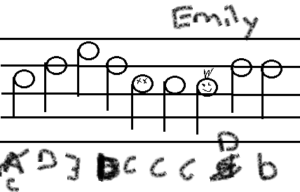
“Miss. Emily. What is that note? That one, right there?” Mr. Lanza asked with more patience than I deserved, because after many weeks, I still didn’t know. “Every, Good, Boy, Deserves, Fudge. Remember? Every. Good.” His pointer scratched and thumped the page propped up in front of me with every word. “Every. Good.” He repeated, and I realized that I was being prompted.
“Boy! B! It’s a B.” I said.
“It’s a B.” He said in the tired voice I was becoming to know.
“Mr. Lanza?”
“Yes, Miss. Emily.”
“Would you play it for me, so that I can hear what it’s supposed to sound like?” I asked.
This was my usual request, one that he was reluctant to indulge but always did. And it worked. I could feel the stress lift from him when he played. His odd, hairy knuckles gently curled as he plucked delicately at the keys. Not only did this break the tension, which seemingly straightened his spine, but this was how…
I learned all the pieces assigned to me; I watched his fingers, memorized the keys, and secured the melody to my mind.
After we switched places, he was taller than me again. The music changed him; it had the power to lighten him. The always proper Mr. Lanza would be slumping again with the turn of a new page. My random jabs at the organ keys, my wandering eyes over the foreign lines and notes, weighed him down. Biding my time, I waited for his pointer to slap the page, a sure sign of his growing irritation with his unteachable student.
“Mr. Lanza?”
“Yes, Miss Emily?” He asked,his question was more of a sigh of exhaustion.
“Could we maybe play at the piano?”
Beneath his large, caterpillar-like eyebrows, his gaze slid from me to the piano and then back to me.
Did he know that this was an effort to distract?
With a slow nod, he seemed to decide on something bigger than switching instruments. With that, I pulled the music book from its decorative stand and sat in aw behind the enormous beautiful piano. That particular piece did not sound any better, even to my ear. In fact, I was sure that my playing alone was an insult to the baby grand’s craftsmanship.
The agony did not last long before we heard my mother slip into the adjacent waiting room. Her boots bumped off the snow as quietly and politely as possible. With that, Mr. Lanza stood and tugged at the bottom of his jacket.
“Miss. Emily, I would like you to work on your scales now.”
“Alright, Mr. Lanza.” I said, happy to be at the end of our lesson even though it seemed rather early.
That’s when I heard it.
I had completed the scale in C major. Set in the pause as I repositioned my hands, were the harsh tones of my teacher. Straining to decipher my mother’s soft words, Mr. Lanza’s were unmistakable. Bass travels further than treble. Did you know that?
“Give up on this one, Mrs. Wright.” He said.
A stone I hadn’t known to be on my chest swelled coldly until it pressed against my throat. It was hard to breathe and harder to swallow. With panicked trembling hands, I flipped the pages of my book nervously as a way to drown them out. Not wanting to hear the rest of their conversation, I busied myself by playing C major scale again and again, not daring to make a mistake. Pain shot through my lips as I bit them together in hopes to will my eyes not to well up or drop tears on his beautiful piano keys.
Rejection, even if warranted, can leave its scars.
“Emily. It’s time.” My mother said, and I slipped between them and out the door as soundlessly as possible.
The car ride home was quiet and cold. The December dark had swallowed the early evening sky, leaving even the clouds lonely. The heater blasted, but offered no comfort. There, I waited through her deafening silence because I knew that she was beyond mad.
I had disappointed her again with my failure to learn, my defiance to play, and my betrayal of the organ.
She never told me that I would not be going back to Mr. Lanza’s, but the icy spot on my heart knew that I would never see the kind man again. My chance to say goodbye and thank him for his hopeless efforts was gone forever.
It was four years later when Mr. Lanza made it through to the forefront of my thoughts.
My grade six teacher loaded a wire contraption that held and aligned 5 pieces of white chalk. Immediately after pressing it to the blackboard with one long straight stroke, I recognized the music stand of my childhood books.
For the first time at school, I was familiar with a lesson before my teacher could begin.
In every space between the lines, Mr. McGregor drew a circle. In each circle, he wrote a letter. F-A-C-E. Then he moved on to the lines. In these circles, he wrote E-G-B-D-F. I saw it! For the first time in my life, I saw it. Right there laid out in front of me, so simple, so basic.
Before I could stop myself, I was standing. In the middle of my classroom staring at the chalk board. “I get it! I finally get it!”
The jeers and snickers from the other kids were easily ignored. My fellow classmates did not faze me. It was as if someone had flipped on a light and I was finally able to see. The joy I felt bubbled up and fizzed, making sitting an impossibility.
The stars had somehow aligned, and I could see something that had been right in front of me all along.
One disapproving glance from Mr. McGregor did not dash my enthusiasm, but it sobered me enough to take my seat.
For a long moment, I could only stare at the two distinct note arrangements on the board. Right there in black and white, I could see the piece that was missing from the beginning. The alphabet. Why would you separate the notes by lines and spaces to come up with ridiculous sayings?
“The spaces are F-A-C-E and the lines make up Every Good Boy Deserves Fudge; E-G-B-D-F.” They would say.
When you put them together, you get E-F-G-A-B-C-D-E-F. Why would no one ever point out the already known pattern of the alphabet?
Did no one ever consider that there might be a different way of teaching, especially when faced with a student who seems unteachable but not unwilling?
I am dyslexic, and this is my brutal truth.