I have a shoe box in my closet filled with poems, essays and short stories. All writings from years ago when I was earning my university degree. Now my email is brimming with drafts of anecdotes and ranting spiels. There are even flash drives with manuscripts and screenplays to boot somewhere. Until recently, I lacked the courage to share. The truth is,I am a story teller, a philosopher and a survivor who many look to for advice, opinion and insight.
I have decided not to let my insecurities about putting my words to print continue to be my accuse or deterrent not to share. Please enjoy.
Seriously, in percentages, how much does romance matter?
Importance of Sex – pixteller
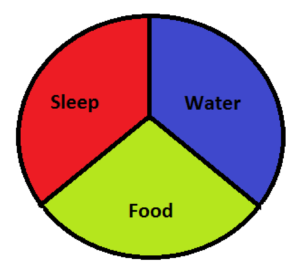
Health Trifecta
At the very least, we need food, water, and sleep to survive. When a cold or flu takes hold, these three components are essential in restoring our health and strength. A relationship is very much the same. As its own life force, it too has requirements to exist. These crucial elements ought to be thoroughly evaluated and weighed when a relationship is in need of a checkup.
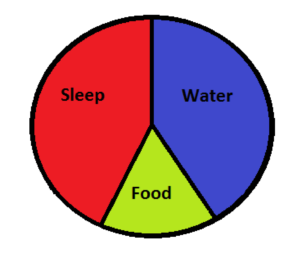
Health 2 Trifecta
Experts cannot agree on the perfect balance of food, water, and sleep to remain healthy. This is because it varies from person to person. Age and activity level are both significant factors that help determine an individual’s perfect balance. Such conditions have the same effect on one’s relationship. The balance continues to be the catalyst for harmony.
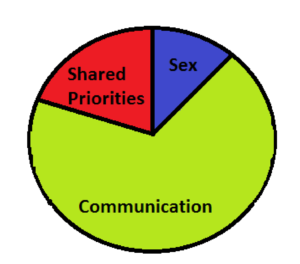
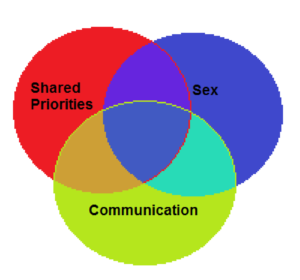
Communication, shared priorities, and sex are the essentials of a relationship.
That is not to say that they are the only components. Family, finances, free time, future plans along with a slew of factors that don’t start with ‘F’ contribute to the overall wellness of your bond. But if your relationship has come down with a cold; communication, shared priorities, and sex are the foundation. Everything else can melt away.
Sex is not only a primal need, but it is also an expression of love, togetherness and intimacy that can be matched with no other.
This is not to rate the quality or quantity of your physical relationship. Follow the seduction links if you need help with that. This is a way to gauge the importance of sex in your relationship.
Understand that this is an ever changing number. Commonly, there is a very strong co-relation between quantity and importance. Those who feel that they aren’t ‘getting any’ or complain that it comes about too rarely will often put a greater importance on sex in the relationship.
Consider a long-distance relationship or when someone in the couple travels; the prolonged union is often extremely sexually charged. Why? Sex is the only component that cannot be satisfied across the distance. Phone sex is a small consolation, a temporary substitute – but I encourage THAT all the same.
Sex Health Trifecta
Another example would be make-up sex. Far from boring, this particular form of lovemaking is known to be fiery and explosive. Why? Because too much communication about shared priorities has squeezed out or neglected the sex element. Like any starved flame – it flares at the slightest hint of oxygen.
The point is, every couple will find harmony in their relationship using a different ratio depending on where their relationship stands. All that matters is that both parties agree on that number.
If you have just had a very ‘active’ weekend away, you should find that sex carries less weight on the importance counter- for a little while anyway. A new relationship usually has a very high necessity for sex as there is no foundation for communication or shared priorities. Once the couple has established a sense of a history, the other components form root and develop. It is then that their numbers begin to shift.
Here’s the catch. Happiness is achieved when both people agree on the numbers. In order to find that balance, the couple must communicate and establish their shared priorities to determine where sex lies on their pie chart.
The humiliation was not nearly as often but was far more scarring.
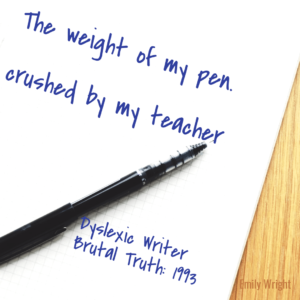
I am dyslexic and here is my brutal truth.
My Brutal Truth
Sunlight pouring in from behind me caught on something unexpected and shiny. I was already flinching when hairy knuckles rapped on my desk. If it were my attention that he had wanted, he got it. His hand in my direct eyeline and the glinting gold band squeezing around his finger had been distracting enough. The startling knock, inches from my face, was unnecessary.
Bent over my desk, I had been lost in my own continuous stream of thoughts, and the ink was struggling to furiously keep up. The words I had been about to scratch down halted at the end of the pen and I willed for my memory to desperately snatch them while I lifted my eyes. Too late, they were gone; at the speed of a thought into the abyss of forgotten fragments of time. Before me was a sentence left unfinished; my train of thought was reduced to a wreck.
More disappointed than annoyed,
…I looked at my Grade 12 English teacher. His back was to me as he walked towards his desk. Lowering himself into his chair, Mr. Fenton peered at me over his reading glasses, made tiny by his rutted round face. When he raised his wiry brows without breaking his impatient stare, it suddenly occurred to me that I was meant to follow.
We were studying Shakespeare’s Hamlet, a play I knew well thanks to Mel Gibson. The remainder of the period was ours to begin the written assignment. Before I reached his desk, Mr. Fenton jutted his chin.
“Bring your work.” This was an obvious oversight on my part, given his tone.
More annoyed than disappointed,
…I approached the big desk that stood demanding respect front and center of the classroom. A sitting Mr. Fenton was at an awkward height, and I could see the oily pores of his slick, near-bald head. It was hard to ignore the heat shooting up through to my ears brought on by the open glances of curious students. An anonymous snort pulled Mr. Fenton’s eyes from my paper to the instantly quieted class. No one dared to meet his gaze, and before us, a plain of crowns lowered.
The painful silence stretched on while his dark eyes challenged his students. My discomfort only grew. Why was I there? What was going on? Should I grab a chair? What was I supposed to do with my hands?
Doubt and insecurities invaded me entirely.
The scent of garlic polluted the air when Mr. Fenton returned to my work and huffed. Never had he apologized for his weakness for the cafeteria Ceasar salad; an omission he often made as an explanation for his sour breath.
Our assignment had just been given to us at the beginning of class, not even twenty minutes earlier. What could I possibly have written that would warrant this much scrutiny? How could he evaluate me on my preliminary notes, which were more of an illegible flowchart?
“Blood.” He finally said, and I nodded.
Realizing that he wasn’t looking at me, I confirmed with a typical teen response. “Yep.”
“Yes.” He held the ‘s’ until garlic tainted the air again.
“Yes,” I echoed.
Referring back to my paper, he started listing off all of my points thus far. I wasn’t about to lean over his desk to follow the tip of his fancy pen as he tapped it around my written notes. Even at sixteen, I was well aware of the scene that would create. Self-consciously, I slid the small charm at my throat back and forth on its chain while taking stock of my shirt with its scoop neckline. Nope. No leaning today.
“All of your examples are in the literal sense. Battle, death and sickness.” From over his shoulder, his eyes found me again. “Come on, think. What else?”
I knew that I was staring at him blankly, but not for lack of an answer, more from the pure shock that I had been centerd out like this.
Although I felt colour rise to my cheeks, my lips grew cold from my gaping.
Suddenly, Mr. Fenton rolled back and stood, snagging the attention of the entire room. “You sit here and think about it.”
“What?” I could not keep the chilling surprise or volume from my voice.
Equally confused expressions looked back at me from the rows of my peers. Mr. Fenton’s fingers curled around my upper arms and dug in as he plopped me into his chair and steered me towards his desk. Panic and embarrassment swelled inside me, and a bolt of pressure raced to my head. Wildly, I scanned the room looking for a kind understanding face when I spotted a friend. Her contorted mouth said it all. Clearly, the odd behavior of our teacher had not gone unnoticed, but…
…no one else felt the uneasiness coil coldly down their spines.
Paralyzed by fear, forever tethered to the fourth grade, I sat motionless at the front of the room. Feeling so small and fragile, a single breath could cause me to break. My mind whirled around the senseless humiliation. I tried to reach back to where I was before Mr. Fenton interrupted my work. Fingers of thought flicked through my memory trying to grasp at anything that had been there, but my pounding heart pulled all threads from my grasp. I had nothing. It was gone.
I picked up my teacher’s heavy pen and lowered it again upon sight of my trembling hands. Did he really expect me to be able to explore the concept of blood in the play more deeply from his desk?
Thankfully, the bell rang blared before I had to find out. Mr. Fenton was leaning on the window ledge at the back of the class when I darted back to my desk to collect my things and flee from the room.
By the following day, I had reasoned that Mr. Fenton had no way of knowing the deeply rooted fear he had inflicted upon me with his actions the day before. So, I did all that I could to push it from my mind and not drag it with me back to English class. I had barely sat down when Mr. Fenton began to bellow instructions to the class. We were to pick up where we had left off the day before, and then, to my horror, he said my name.
‘Ms. Wright,’ he hissed the ‘s’ like a ‘z’.
My eyes snapped to his, and he motioned for me to follow him out into the hall. The mass that had collected in my throat was too much to swallow, so I took to chewing on my tongue to ward off the tears. My heart clobbered so hard that it hurt to breathe.Out the door, I went, but he was already walking down the hall. Then he turned, where I hadn’t known there to be a room. When I got there, it was the side entrance into an office I didn’t recognize. The name on the desk was not Mr. Fenton; it was Mrs. Blackwell, the Vice Principal and my teacher looked disturbingly satisfied as he slid into the big wingback chair. Cautiously I took the seat across from him.
There was one window looking out over the courtyard directly behind the desk, and Mr. Fenton’s glowing silhouette was almost ironic. Shadows created by the few secretaries in the main office, blurred beyond the closed blinds of the wall of glass to my right.
“I see that you have enrolled in the OAC English class next semester.” His gaudy ring caught the sunlight again as he steepled his fingers, pressing his elbows into the soft arms of his mobile throne.
This wasn’t a question and my plans were well thought out and precise. My high school excelled and specialized in the sciences, not my particular expertise. The idea was to take all the required OAC courses needed for my university application as quickly as possible so that I could add electives to my transcript in my final year. That way, I could enroll in courses available at other high school’s from the surrounding area and use my spare class for commuting. As well, English was by far my worst subject, so by taking it early I could enroll in an upgrade summer course, offered only to students who had already completed OAC English.
I had no illusions about my limitations and academic challenges. My plan was to accept my disadvantages and get ahead of them.
It was perfect. Or at least I thought it had been before this blindsided ambush.
“I want you to take a look at this.” Mr. Fenton opened a folder that had been sitting on the plastic desk protector and plucked out papers. He held them towards me, but I had to stand to retrieve them. There were three or four pages neatly stapled together. “That is an essay written by a student of mine last year. It is an example of where you are expected to be. Where your writing should be.”
Flipping through the pages, I feigned interest all the while the date kept flashing in my mind. It was October! The semester had just begun. This was hardly enough time for teachers to learn all of their student’s names, let alone their potential. How could Mr. Fenton possibly know anything about my writing? We had yet to hand in a single assignment. The next thing he said tore me from my thoughts.
“I think that you should drop out.”
I froze without being able to look up.
These few words crushed me.
“I teach OAC English, and you don’t have what it takes to pass that class.”
After that, I didn’t hear anything else he had to say. He had just obliterated my plans for high school, shattered my expectations for graduation and quashed any hope I had for getting into university. I had been judged and unfairly evaluated without any grounds or cause. There had yet to be anything for him to come to such a rash conclusion. I vaguely remember nodding and floating out of the room.
Three months later,
I sat hunched over another desk. Rows of them had been set up in the gym for exams.
It was believed that lower temperatures were stimulating and more likely to keep students alert. I must have been the exception because being cold made me want to curl up and sleep. Being my third exam, I had come prepared with a piping hot tea, a giant box of tissue and a toque. The thick wool of my puck bunny sweater helped too. Before me was my English exam, and I was ready. There was no stressing because I knew my stuff. It helped too that I wasn’t enrolling in OAC English until September, which knocked my plan off course by a year. By dropping the course as suggested by my teacher, I would not be eligible to apply for university until the year after my classmates; a reality I had learned to accept over the last few months.
A hairy knuckle dropped onto my desk, knocking mere inches from my pen. The scent of garlic had preceded him. Beneath my enormous sweater, I stiffened and gripped by Papermate so tight the tips of my fingers turned a ghostly white. Then, Mr. Fenton crouched beside me. So close, in fact, that I could see a roll of skin attempting to fold over the wire arm of his reading glasses in my peripheral. This time I did not lift my pen nor turn to him; my sights were set on the last few words to finish my train of thought. He seemed to wait, but still I wrote. Finally, Mr. Fenton placed my last assignment upon my desk. The grade was hard to miss in its giant red ink.
Our final independent study, making up 40 percent of our final grade, had multiple components. Mine was on a local poet, and after much research and obscure digging, I had discovered the poet’s glossary. As if he had his own language, I used the glossary to decode and translate a number of his poems. No doubt about it, this poet was a sexist womanizer, and I said as much in my oral presentation, except I think I went as far as to say he was a pig.
There I was, where I shone brightest at the front of the class, prepared to present on a topic I knew inside and out. Having a completely entranced, captivated audience was exhilarating until my teacher interrupted. As luck would have it, or my bad luck as it were, Mr. Fenton knew the poet. They had gone to school together and shared pints just a few weeks earlier. This blow took the wind right out of my sail. I had just openly trashed my teacher’s buddy.
After a long awkward moment, Mr. Fenton choked out a laugh and announced that I had ‘hit the nail on the head’ with all that I unearthed;
another potentially brilliant day gone badly.
That had been weeks earlier, and the anticipation of my grade for that blunder of an assignment had been overshadowed only by my exams. I gleaned no insight into my results, not through rumor nor teacher’s meeting. The hopefulness I had for the written component withered. Let’s just say that my presentation had been kind and humorous in comparison to the strong language I used in my essay.
Words like predator and pedophile lack comedic value and sharpen the edges of real accusations with well-argued points. Learning my teacher knew this poet personally was enough for me to enroll in summer school to redo grade 12 English upon my certain failure of the class.
Staring down at the bleeding red ink, a 98 looked back at me. Disbelief snatched my response as I forced myself to consider the mark. Percent, right? Was he for real? The air in my chest turned to lead, and a flood of emotion took hold, rattling me to the core.
Flattening his hand over my paper, Mr. Fenton’s football ring failed to glint under the harsh fluorescent lights of the gym.
“I underestimated you. Good job.” Still, I stayed silent. Standing, Mr. Fenton slipped his oversized hands into the little pockets of his suit jacket. “It’s too bad that you dropped my course next semester.”
To that, I could only dip my head.
Again, he had crushed me
…and I refused to allow him to wreck my thoughts. The scent of garlic faded as he strolled away.
Undefined emotions milled about my brain until my eyes landed on my pen. There was a task at hand that deserved all of my attention. After a number of centering breaths, I absentmindedly slipped my near-perfect assignment beneath my exam and continued to write.
Not every day at school was dark, but the saddest were those when I was evaluated.
In 1986, I was tested again and never told of my learning disability; dyslexia.
Every time they pulled me out of class, I wanted to cry.
As if trapped in a spotlight without warning, the heat instantly burned my cheeks. Sweat broke at my hairline, and my skin grew hot before my teacher could speak my name. The urge to grit my teeth and glare defiantly at the chalkboard was strong. Refusal to leave was clear in my unwillingness to move or even look toward the stranger at the door. But that would have only created an even greater spectacle.
So instead, I rendered myself invisible by disappearing as quickly and quietly as I could.
My sadness was like a stack of books weighing me down.
Not one destroyed day in particular stands out. No actual dates mark my ugly calendar of baggage. I only remember being yanked from every class at least twice a year. The slow walk down the empty halls to yet another tiny office unknown to students was unforgettable. As was of course, the relentless testing. These memories are impossible to tear from the childhood scrapbook in my mind.
Tattered pages of condescension and patronizing. Each time I was visited by a different, what? Educational therapist? Academic analysis? Learning behavioral specialist? I never caught their title, and didn’t care to know their names.
Recounting these sessions makes me sad.
Sad
No one ever asked me if I wanted to go. And no one ever told me why I was being tested. I may have been more cooperative if I had understood the long-term benefits of a conclusive diagnosis. Instead, I lashed out by purposefully foiling their exercises. My parents weren’t even aware of these backalley assessments. Nor did we ever learn of my results. I took this to be positive, like the adage, ‘no news is good news.’
I assumed I was being tested because I was stupid and THEY (the faceless ‘they,’ no one ever calls by name or identifies). They wanted to know how stupid I really was. They wanted to determine if I was deserving of my current grade, or whether I needed to attend an institution.
Staring unfocused at something just over their left ear while allowing spittle to collect at the corner of my lip was tempting. If only to give them something more to report than…
…my inability to read.
But I was terrified of where that might land me. A rubber room, perhaps?
A kid in my class once said that I was being interviewed for special ed or the community living classes, as we called it back then. I wasn’t sure what the outcome of my results would bring and fought the strain of tears that threatened. Rage and frustration flooded my view and marred my perception.
It was not until university that I discovered I had a learning disability called dyslexia.
Did they really think that they could pluck me from class for an hour and have me return without notice?
As if elementary kids are known for their empathy and sensitivity. Discretion was a given. My classmates would just pack away their curiosity and forget that one student was allotted special treatment to miss out on math class. Right? No one would ask questions about or mention my absences. Understanding runs rampant in schools, right? I thought I was supposed to be stupid. Inevitably, some kids would say I was lucky to get out of class and assume that where I went was fun. They would argue favoritism and demand the same opportunities. Until another kid not so subtly announced that…
dumb kids don’t get perks.
It was so unfair and disruptive. It took hours before something else would steal away their attention and I could curl back into myself.
And all for what?
It wasn’t as though it changed anything. Once my brief absence was forgotten by my fellow students, life returned to normal. I would continue struggling along through school, doing my best to blend in, and avoid outing my stupidity, until the next surprise evaluation.
I learned later in my academic career that all of my teachers knew of my learning disability. They weren’t allowed to mention it to me or my parents, only suggested extra help with reading. They couldn’t advise my future teachers to prevent bias against me. Hah! Each of my teachers had to figure it out on their own that I had a learning disability. By the time they got to know all thirty of their students and deciphered my limitations, we were halfway through the school year. Cue the evaluation request. Oops, we ran out of time. Push her through to the next grade and see how she makes out.
Back then, there were no resources for kids who required alternative methods of teaching. I was considered an angry kid who grew up to be an outspoken, opinionated, angry teenager. Several factors played a role in my attitude, and my earliest memories of school account for too many. I remember finger painting in kindergarten.
There I was, standing at the easel in one of my dad’s old shirts backwards so as not to spoil my clothes. True to myself, I refused to do what was expected or what the other kids were doing. So, my grass was blue and my flowers were green. The paint was mucky on my hands while hardened blotches cracked on my face. It’s a vivid memory, and I will never forget the red. That was the colour of the X at the top of my page left by my teacher. It was out of place. It was a mistake. How could my finger painting; a child’s artwork of flowers be wrong? That X scarred me. Two deep cuts branded me, misplaced and cruel. I knew that there was something wrong, and it was not me.
In grade two, my teacher played an instrumental song, and we were all told to draw what we thought of as it played. Everyone recognized the tune. It was the familiar theme of Zorro. I knew that everyone would draw a horse galloping or a masked man riding the range. I pictured a dancer jumping and twirling. My ballerina may have been pretty good, if not for the giant X scratch through my paper. There it was again. At first, I thought my teacher had meant to draw a Z. Until a painted fingernail pointed at my page. ‘That’s wrong,’ she said without compunction or apology. I was wrong. The air in my chest was too heavy to heave. The hurt was too bitter to swallow. I fought the urge to run from the place I clearly did not belong.
To this day, I harbor great resentment towards red pens and Xs. They lack compassion, originality, and articulation. They are for the weak and the lazy. Especially in subjective matters. State your case and use your words if you don’t like something.
This was my reality throughout elementary school. High school was worse. But that’s another story.
Until 1995, I was unknowingly having dyslexia. This is my brutal truth.
Being accused of fraud was one of the best things that ever happened to me.
Fraud. This is exactly how I felt attending University- a fraud. Somehow, I managed to graduate high school with a GPA that snagged an acceptance to my preferred post-secondary education establishment. This was a feat in itself because…
I pulled through high school without reading a single book cover to cover.
My trick? Well, I took impeccable notes, that only I could translate, and I made a point of writing essays that regurgitated the opinions of my teachers as discussed in class. I wore a path in the library carpet directly to the Cole’s Notes section and specifically chose books that had been made into film, no matter how obscure. Imagine what I could have done if Google had existed back then. Anyway, all of my diversions into reading worked like a charm. Or so I had thought.
Until the day I was asked to stay after one of my first-year university tutorials.
Upon hearing my name, I froze; a familiar panic taking hold. In spite of the heat that instantly brightened my face and the pulse that throbbed hotly, scorching my veins, I could not move. This should not have come as a complete surprise. After all, everyone but me had had their midterm papers returned to them at the end of class.
My T.A. was about five years my senior; a fact that only made the ‘no-notice’ discussion bearable. Well, far less intimidating than if it had been my professor, that is. As I approached the vacant seat reserved for me, she slid papers from a folder. Immediately, I recognized them as two of my own assignments. One had been a five page, take home article; typed double spaced as required. The other was a handwritten, in-class essay.
Hey, it was the nineties.
She tapped her capped pen on the typed title page. “Who wrote this?”
The question shocked me into silence. It was a long moment before I closed my mouth and blinked the dryness from my eyes.
“I did.” My response was no more than a squeaky whisper.
This I had not expected. I had assumed and prepared for a bad mark and…
yet another conversation that gently suggested that I drop out of the class.
See, dreadfully low grades mess with the bell curve, and no professor wants that. Thankfully, final grades depend on more than just the written component, or I would never have made it out of fourth grade. It was always the shining marks I earned through oral presentations, class discussions and in group work that pushed me through.
“You didn’t get someone else to write this?” She peered at me without expression.
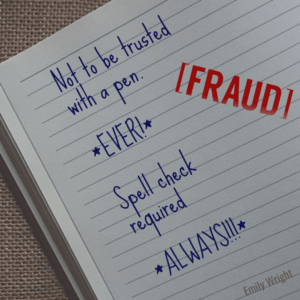
fraud
As the implication of what she was suggesting sank in, the stinging strain of tears flooded my vision. My balled fists began to tremble beneath the tabletop with the hopelessness of my predicament. All I could do was shake my head. My future hung in the balance and under her severe scrutiny I was crumbling. Finally, she sighed and pushed back in her chair.
“Then explain the drastic difference between these two papers.”
“Prep time and spell check.” I deadpanned without missing a beat.
Straightening again, she bounced her pen relentlessly upon my in-class essay. It was a blur of blue arching from her fingers. Was she weighing her words or measuring my response? Suddenly the tapping stopped, and the uncomfortable silence brought my eyes to hers.
“This one is unreadable.”
I knew that she was not talking about my handwriting. It was my countless spelling errors and nonsensical rambling. When writing, my thoughts stream so rapidly that the ink is unable to keep up. What is worse is that I am blind to my own errors. When I was able to type assignments, leaving them to the last minute was never an option. My first draft was often in point form to get all of my ideas down. The second draft, I would string those points altogether into a coherent format. Then, I forget about it for as many days as possible. The time I allotted was literally so that I could forget. My words needed to fall from my memory and sentence structure grow unfamiliar so that I could edit it better.
I was holding my breath waiting. Waiting to be expelled for fraud or being kicked from the program for being too stupid the belong.
Her next words changed everything.
“You, my dear, are dyslexic.”
With that, she stacked my papers and aligned them perfectly by tersely dropping the edges on the tabletop with a clap. The expression she wore was unreadable as she pushed the sheets towards me.
“I strongly recommend that you make an appointment to be evaluated at the learning disability center. “
I took little notice of my T.A.’s leaving but she must have. Once I had composed myself, I realized that I was sitting alone in the cavernous classroom. Relief washed over me. I wasn’t going to be expelled. And I dared to be hopeful with the idea of being evaluated at the learning disability center.
Last year at this time, I felt completely overwhelmed. There was something every day. And by ‘something,’ I mean that one thing that has the potential to flick an entire day into a tailspin. It is imperative that I be hyper-organized. I am a working mom who volunteers, and my kids are enrolled in multiple extracurricular programs. My husband is the key to daily success. He is almost as essential as the over-crowded, colour coded, calendar.
One thing can derail everything!
A missed appointment, a car in need of repair, or a last-minute meeting at the school can throw the entire schedule off kilter.
When that ‘something’ happens, it is like grasping at ink in water.
I juggle three and a half lives; mine, my 2 kids and 1/2 of hubby’s (this is a settled-upon agreement). When a wrench is tossed into the mix, all the balls come tumbling down and pummel me into a migraine.
Last May, the dentist had left a friendly voicemail reminding me of an appointment for my son. Unfortunately, I was listening to the message at the exact time that we were expected in the office. I had been defeated and promptly fell apart. How could I have missed this? I am organized and put appointments on my phone and on the calendar! What made me ever believe that I was capable of managing 3.5 lives? Fail!
Determined not to have this happen again, I programmed a reminder of this dreadful month into my cell. It went off.
Brace yourself!!! It’s May! Mark everything on the Calendar!
I read this and laughed because I was on the ball. All scheduling was in order and under control.
May
A few days later, it happened.
May tends to inspire spontaneous activities. The nicer weather encourages teachers to hastily squeeze in last-minute field trips, fundraisers, and short-lived sporting events. Everything gets crammed into the last two weeks of May with very little notice to parents.
‘Short notice,’ ‘last minute,’ and ‘spontaneous’ are the sworn enemies of ‘A’ personalities and most highly functional moms (and dads)!
The long weekend in May is a common target date to launch meetings, first practices and exhibition games for summer sports and activities. It’s like a race to schedule before we all lose that Monday. All the while, spring programs are only counting down the number of weekly meets until the end-of-year celebration. This does not mention the everyday icons on your calendar: vet, dentist, doctors, birthday parties, oil changes, cleat shopping and on and on.
Double bookings are my favourite! You must divide and conquer, or you will never survive!
It is as if May just smiled with a head tilt and said….
“Happy Mother’s Day!”
Now, every appointment, activity, and obligation you have ever known will come crashing down upon you in the form of a voicemail, permission form, or smartphone notification.
What I am trying to say is that it May not be you! You May be highly functional and uber organized; May is not. In fact, it was sent here to test our sanity and remind us that sometimes, some things just cannot be done.
You are not alone. May you remain calm and stress-free. June is on its way! Give yourself a break!
Every day at school, a feverish nightmare was likely to occur. Back then, I was unaware of my learning disability and knew nothing of dyslexia.
This is my story. A brutal truth: unknowingly living with dyslexia in 1984.
Fever
“… fever…”
Fever should rhyme with never. Right? This was my only thought as I stared at the foreign word. Standing at the front of the room, I could barely see over the podium. I clutched the open book in my hands. The black letters swelled as the many faces of my grade four class blurred and shimmered in my peripheral.
“What?” Mr. Moir asked, not bothering to leave his desk.
Instead, he pinched the bridge of his nose from beneath his glasses. He was a stout man who liked to wear the color of oatmeal. Strands of hair laid like lines in the sky after an air show, lay across the top of his glossy head. There was no sympathy in his expression once he dragged his palm down his rough chin. He looked tired and even a little annoyed. Meanwhile,
I was the one facing my worst fear;
Standing in front of my entire class, reading a passage I had never laid eyes on before. It took everything I had not to cry or pee my pants, and my teacher looked bored.
He scratched the air with his finger as a gesture for me to bring the book to him. When I did so, I pointed at the word with my chewed-down finger nail.
“Fever.” He said these two ugly syllables in a way that showed his crowded bottom teeth.
I had never been eye level with Mr. Mori before and did not care for it at all.
“Fever.” I echoed in a whisper. “But it looks like never,” I dared to explain.
His face crumpled as if he were refraining from saying,
‘stupid girl.’
Then, from behind me, the tempered giggles and snorts that I ignored became alive. The entire room erupted into laughter, and I saw the jagged line of Mr. Moir’s teeth again. He too, was laughing.
My face grew hot, and my eyes burned. I felt so small and naked. Ice-cold realization hit me;
this was where my nightmares lived.
Closed in by the chalkboard wall, the giant teacher’s desk, and the podium, trapped by fear and humiliation. This moment stretched on and slithered around me, swaying the room. Once the clatter of laughter subsided, there was no apology or even pointless face covering. He did not ask to return to my seat. Instead mercilessly, Mr. Moir pointed to the podium.
This is my story. A brutal truth: unknowingly living with dyslexia in 1992.
My Brutal Truth: 1992
High school is a lonely and unkind place for a student struggling with a learning disability that no one talks about. Anger is an emotion easily sparked.
“What is wrong with you?” Her question alone was heart-wrenching, but the tone nearly earned her a slap.
The lines being read aloud were slow and careful. The unbearable silence that followed her intrusive question made me tremble.
A group of us had gathered in the only classroom with a carpeted area and fabric covered-furniture. I had just landed a speaking role in the high school play, and we were meeting to do a run-through. Clueless as to what that meant, I hadn’t known to be nervous. I was still humming from the excitement of being a cast member. This was a really big deal for me. There were many exceptionally talented kids at my school. The auditions had been a testament of that. Beautiful voices, amazing dancing, and tremendous acting commanded the stage, and I had not felt worthy to claim a spot.
There I was, with the script in my hand, sitting among the best and brightest. I was in awe. Then the reading began.
Cue the panic.
The lead male role was awarded to a very popular, charming and ridiculously hot senior who was a triple threat. In fact, he still is.
When he read, my heart swelled as I listened in amazement. No one seemed uncomfortable or worried about reading their lines. I, on the other hand, was fearful of peeing my pants. Luckily, I only had two lines, one in each act. There was plenty of time for me to find them and burn them to memory before my character was introduced.
The star of the show was speaking very slowly and carefully. This affected me deeply. I was thrilled that he read like me, except without any of my visible anxiety. So, when the girl beside me interrupted him with her outrageously rude question, I am sure I bared my teeth.
“What is wrong with you?” Her wrinkled nose and furrowed brow froze on the last word.
A long, dreadfully awkward moment passed, and something inside me fractured for him. He looked at her and then passed his gaze over all of us.
“I’m dyslexic.”
He said this evenly; simply. With was no apology. It was a fact that he shared in a way that made it her problem, not his.
The breath I released once he returned to his lines was one that I had been holding my entire life. I was amazed by him and this revelation of not being alone was truly freeing. A bubble of glee made me grin when the ignorant girl beside me raised her script to conceal her blazing cheeks. It was a beautiful thing.
Even to this day, he has no idea how the delivery of those two words changed my life. Before then, I had never heard of dyslexia nor had I known anyone to openly admit to something so hushed with such confidence and conviction. He was unaware of the impact that he had on me that day. And I wish I could say I was no longer afraid, but that would be a lie. Just learning that others struggle and prevail with dyslexia was immensely inspiring.
For that, I will continue to write.
I am a dyslexic storyteller, and this is my brutal truth.
This is my story. A brutal truth: unknowingly living with dyslexia in 1990.
Eventually, the constant chatter over my panic attack seizure, AKA choking episode, quieted. The most recent and dramatic stunt yet, to get out of reading aloud. The attention of my classmate’s was quickly claimed by other gossip and more pressing events like grade eight graduation. Until of course, I was called to the principles office one beautiful spring day.
This happened a lot, but the sinking feeling in my stomach told me this time would be different. The principal and I were on better speaking terms than almost all the students, even some faculty memebers. This was because I spent a lot of time in the office. Three days a week, I volunteered to answer the phone and file documents over the lunch hour and after school.
This was one of the many perks of having a teacher’s daughter for a friend. In grade eight, my friends had a huge impact on who I was. Not only was I lucky enough to have beautiful, popular friends, they were all brilliant. I mean honor roll, enriched classes, smart. I guess that guilt by association isn’t always a bad thing. Many people assumed that I was a brainiac too because of the company I kept. Who was I to argue? But, boy, were they wrong.
Volunteering at the library probably reinforced this false image of my high intelligence. Yep, illiterate me, worked in the library and was good at it too. I took the Dewey decimals system very seriously and was nice to the librarians. Meaning, I acknowledged them and recognized them as being human and not just moving figures within the aisle of books like most kids at my school. I am sure that had something to do with their requesting me specifically to help rid the carts of returned books.
This walk to the office, however, had nothing to do with my volunteer work. I could feel it; something was up.
The secretary ushered me into the principal’s office as soon as I arrived. His door was already open, and he sat at the conference table, not at his desk. The sunshine streaming through his wall of windows muted the features of his face. So it was not until after our pleasantries that I noticed his weighed-down expression. He was unreadable, but my instinct told me to worry. The clunk of the door closing as I sat down vaulted this bad feeling into mild anxiety that was quickly hurting towards panic.
Before him was a very official -ooking document. At first, I thought I had interrupted his work. Still, I had no clue what I was doing there, in the principal’s office during class, just the two of us.
Even at fourteen, I understood that his polite questions were an attempt to disarm me as a preamble to the bad news. Yet, I still had not expected him to refer to the sheet of paper on the table. After slipping on his glasses, the principal explained that he did not have time to read all of the papers that crossed his desk. Instead, he skimmed them by reading the first and last sentence of every paragraph. My throat started to close with the onset of panic, but I managed to smile and nod; my ‘go-to’ response in the face of anxiety.
Oh, no! He was going to be asked to rea legal adult jargon – ALOUD!.
Before my attack had a chance to alter my breathing, he told me that I should use this method to help me read more quickly.
Over his glasses, he pinned me with his brown eyes. I almost peed my pants. Then, his weathered face quirked into a smile, and I was dismissed.
I didn’t get a chance to thank him for the tip even though I knew it would not work for someone like me. By the time I sifted through a paragraph to find the beginning of the last sentence, I may as well have read the whole dang thing. That was the thought that carried me back to class until another one stopped me in my tracks. My principal had been troubled as if he had a big decision to make. He alone held my future in his hands.
He would determine wheather I graduated with my class or was held back to repeat grade eight.
DW: Fear
The fist of fear that clenched my heart was enough to bring me to my knees. I fought it but was not so lucky in holding back the well of tears that stung my eyes.
Never before had I been pulled into his office discuss my studies lightly. That hadn’t been a polite preamble. That had been the entire point of the meeting. The panic started to rise again.
Would he really hold me back?
Three weeks later, I got my answer. In a puffy-sleeved dress with big fluffy bangs to match, I was the happiest of grade eight grads.
High school, here I come. It couldn’t be worse than public school. Right?
was an everyday occurrence for me in school. Back when I was unaware of my learning disability and knew nothing of dyslexia, all I felt was stupid and panic when singleded out and forced to read.
This is my story. A brutal truth: unknowingly living with dyslexia in 1989.
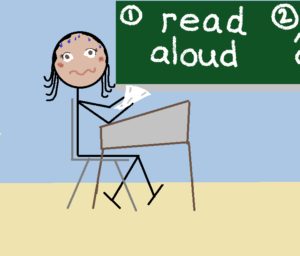
Panic has got to be the worst sensation next to dying. Everything seems to happen at once. My throat goes dry, but not before an impossibly thick lump forms. My vision begins to blur around the edges, and my limbs go numb. Then, there is the internal turmoil. My lungs don’t stop working as much as I forget to breathe. I can feel my heartbeat thrashing against my ribs, and my lunch squirms, its way around my gut. All of this because my grade-eight teacher has just passed around the school’s code of conduct that we are expected to read aloud in turn.
Dyslexic Panic
Once the roar of my pulse lessens, I can hear and I realize that we will all be assigned a paragraph. Frantic blinks restored my vision, before I could calm enough to count the number of students that should read before me, as a way to find my paragraph. This routine is all too familiar but no less stressful. I read my part over and over in hopes of burning it into my memory. This is doable, I assure myself in hopes of calming my body’s commotion.
My breathing is almost back to normal when I hear my name.
Looking up, all eyes are on me. Panic rises again as I realize that the person next to me hadn’t been reading. I was to read after them, now all preparation time was lost. The teacher has switched directions on me and it is now my turn. I haven’t a clue where we are or how to find this foreign paragraph that I have never laid eyes upon. Bile curdles in the hollow of my stomach and I feel my face grow cold.
Before I can think, I throw myself onto the floor seizing. The shaking is so violent that I whack my head on the leg of my chair. But that doesn’t hurt nearly as badly as what happens next.
All the students are on their feet. Desks and chairs screech out of the way. Girls are screaming; some are crying. I hear the teacher order someone to the office when I am picked up like a rag doll. Massive arms encircle me while a double fist slams into my chest. The first blow nearly breaks me in half and the fifth surely busts a rib when my lunch decides to make an entrance. At this point…
vomiting is more or less involuntary.
Faking a seizure seemed like a good idea at the time, although I failed to have an exit strategy. I did not foresee Randy Caligan the captain of the basketball team and Boy Scout extraordinaire, to jump to my rescue. He was so eager to perform his newfound skill the Heimlich maneuver,that it didn’t matter that I was not choking.
None the less, minutes later, there I was in the dimly lit nurse’s room, a complete and utter hot mess. With sore ribs, a bruised chest, and bloodshot eyes, I curled up on the prison-style cot and waited for the final bell of the day to ring. The puke scent that I called my own was inescapable. Still, this was a far better outcome than having to read out loud.
If you sweep things under the rug, eventually someone will trip over the lump.
In my experience, it is best to wait for the fire to die out before revisiting the source of the inferno. For the passionate, this is not easy.
Be patient
It is all too tempting to hash it out, right there and then, while still flush from its heat. Sometimes this can result in a hefty helping of the Silent Treatment; the heartburn kind. Often, conflict is like an episode of Three’s Company; something or someone has been misunderstood or not completely transparent. Purely open communication is…
…the ability to fully express your perspective to your partner and, brace yourself, seeing things from your partner’s perspective.
It is best to wait until both parties are calm and ready to listen before revisiting an issue. The aftermath of an argument takes time.
Argument Aftermath
Often, couple`s therapists will use tools for listening like the ‘speaking rock.’ The person in possession of the rock is the only one allowed to talk. This means that the one without the lump of stone is to listen. Corny! But it works. If nothing else, a huge spotlight exposes how often we interrupt one another – especially when we don’t like what we are hearing.
I once read on Pinterest,
‘Most people do not listen with the intent to understand; they listen with the intent to reply.” Steven R. Covey
Something to think about the next time your partner is holding the rock. If an apology is in order, and it probably is, see my article on apologies to better your approach.
Don’t
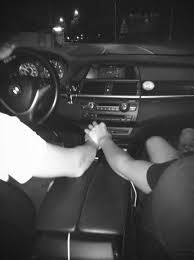
Do Not Use the Car.
Fight the urge to approach the ‘we should talk’ conversations when driving. Why, you ask?
argument aftermath
You have a captive audience. Literally, your partner is trapped with nowhere to go. If they are not ready for this conversation or you are not abiding by the sharing rules of the speaking rock, you will land yourself in a bigger argument and possibly on the receiving end of the Silent Treatment or the law with a speeding ticket.
Trust me on this. Getting out of the car to walk is so clické, but young couples everywhere have been there. Perhaps, it is their flair for the dramatic. But as we get older no one has time for walking (or the shoes because, let`s face it, these talks always happen when we are dressed up) and more often than not we are on the highway.
Avoid Tight Spaces
Even if you have all the best intentions and you promise yourself not to let the conversation become heated, the odds are that it will blow up in your face. Cornered animals tend to jump on the defensive. They turn rabid and snarl. When strapped in and forced to stare straight ahead, there is nowhere for the anxious energy to go. People need their space and freedom to truly express themselves, especially when threatened. Body placement says a lot about what we are communicating; standing wagging a finger, sitting with crossed arms, or even pacing are all conditioned ways to process and respond. We pick these up in our childhood and they are our own coping mechanisms.
Not only does the trapped person need an outlet for this energy but it serves the partner well to bear witness. We take greater cues from one another’s body language than words, especially from our partners.
When a driver is backed into a conversation and stopping is not an option, I promise you that they are visualizing pushing you out of the moving car. Okay, if it was meant to be, they may drop you at the next corner even in their fantasy.
Regardless, the mental message is the same: SHUT UP or GET OUT!
argument aftermath
But to avoid the drama that would certainly follow that scene, not to mention criminal charges, the driver may opt to white-knuckle the rest of the drive. They may pick up speed and begin to drive recklessly and erratically. Do not kid yourself. They are not distracted by the conversation. They are trying to get home as fast as they can to get you the hell out of the car.
Recap
Do not confuse the passenger seat with a soapbox or the car with an interrogation room. If…I mean when, an ugly conversation needs to take place, let it be somewhere that offers an escape. At least at home, if a door has to slam, no one is left on the side of the road (in uncomfortable shoes).